


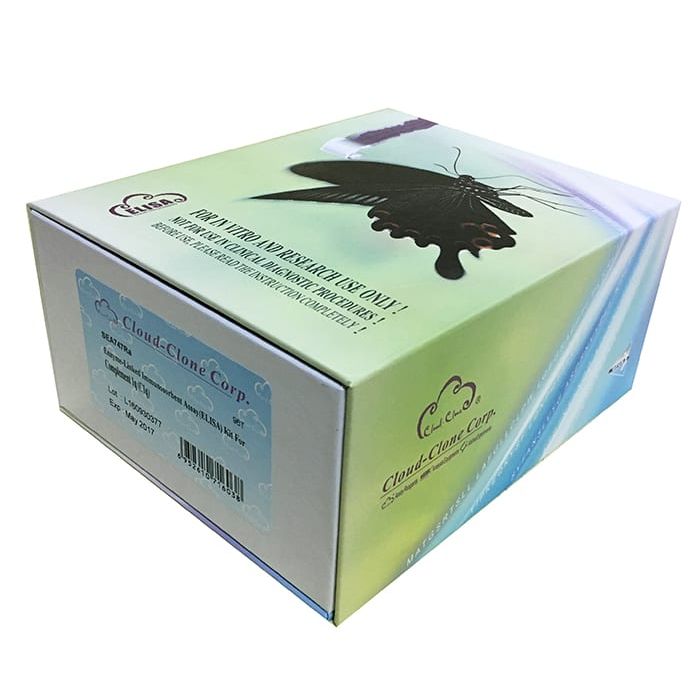
| Product Name | Kim1 ELISA kit (Mouse) |
|---|---|
| Description | This assay has high sensitivity and excellent specificity for detection of Kidney Injury Molecule 1 (Kim1). No significant cross-reactivity or interference between Kidney Injury Molecule 1 (Kim1) and analogues was observed. |
| Synonyms | HAVCR1; TIM1; TIMD1; HAVCR; Hepatitis A Virus Cellular Receptor 1; T Cell Immunoglobulin And Mucin Domain-Containing Protein 1; T-cell immunoglobulin mucin receptor 1 |
| Method | Sandwich |
| Detection Range | 39-2,500pg/mL |
| Sensitivity | 14pg/mL |
| Target | Kim1 |
| Specificity | This assay has high sensitivity and excellent specificity for detection of Kidney Injury Molecule 1 (Kim1). No significant cross-reactivity or interference between Kidney Injury Molecule 1 (Kim1) and analogues was observed. |
| Reactivity | Mouse |
| Sample Types | Serum, Plasma, Tissue Homogenates, Cell Lysates, Cell Culture Supernates And Other Biological Fluids |
| Reconstitution | 1.Prepare all reagents, samples and standards; 2.Add 100uL standard or sample to each well.Incubate 2 hours at 37℃; 3.Aspirate and add 100uL prepared Detection Reagent A.Incubate 1 hour at 37℃; 4.Aspirate and wash 3 times; 5.Add 100uL prepared Detection Reagent B.Incubate 30 minutes at 37℃; 6.Aspirate and wash 5 times; 7.Add 90uL Substrate Solution.Incubate 10-20 minutes at 37℃; 8.Add 50uL Stop Solution.Read at 450nm immediately. |
| Uniprot | Q5QNS5 |
| Storage | 4°C for 1 month/ -20°C for long-term(within shelf life) |
| Notes | Colormetric |
| References | Targeting the AGE-RAGE axis improves renal function in the context of a healthy diet low in advanced glycation end-product content;A Mouse Diversity Panel Approach Reveals the Potential for Clinical Kidney Injury Due to DB289 Not Predicted by Classical Rodent Models;Targeting the AGE-RAGE axis improves renal function in the context of a healthy diet low in advanced glycation end-product content.;Inhalation of hydrogen gas ameliorates glyoxylate-induced calcium oxalate deposition and renal oxidative stress in mice;Vorinostat protects against calcium oxalate-induced kidney injury in mice;Intrarenal Renin-Angiotensin System Mediates Fatty Acid-Induced ER Stress in the Kidney;Deficiency in Apoptosis-Inducing Factor Recapitulates Chronic Kidney Disease via Aberrant Mitochondrial Homeostasis;Once daily administration of the SGLT2 inhibitor, empagliflozin, attenuates markers of renal fibrosis without improving albuminuria in diabetic db/db mice;Synergic Effect of α-Mangostin on the Cytotoxicity of Cisplatin in a Cervical Cancer Model.;Protective Effects of DHA-PC against Vancomycin-Induced Nephrotoxicity through the Inhibition of Oxidative Stress and Apoptosis in BALB/c Mice;Exploring the therapeutic mechanism of Desmodium styracifolium on oxalate crystal-induced kidney injuries using comprehensive approaches based on …;Modeling heart failure risk in diabetes and kidney disease: limitations and potential applications of transverse aortic constriction in high-fat-fed mice;UPLC/MS-Based Metabolomics Investigation of the Protective Effect of Hydrogen Gas Inhalation on Mice with Calcium Oxalate-Induced Renal Injury;Dual actions on gout flare and acute kidney injury along with enhanced renal transporter activities by Yokuininto, a Kampo medicine;page Metabolomics study of fasudil on cisplatin-induced kidney injury;Delineating a role for the Mitochondrial Permeability Transition Pore in Diabetic Kidney Disease by targeting Cyclophilin D;Renal Protective Effect of Beluga Lentil Pretreatment for Ischemia-Reperfusion Injury;Targeting Methylglyoxal in Diabetic Kidney Disease Using the Mitochondria-Targeted Compound MitoGamide;Kim-1 Targeted Extracellular Vesicles: A New Therapeutic Platform for RNAi to Treat AKI;Kidney disease risk factors do not explain impacts of low dietary protein on kidney function and structure; |
| Supplier | Cloud Clone |
PROTOCOLS:
 SEA785Mu
All Research Products are sold for laboratory RESEARCH USE ONLY and ARE NOT TO BE USED FOR HUMAN OR ANIMAL THERAPEUTIC OR DIAGNOSTIC APPLICATIONS. The information presented is believed to be accurate; however, said information and products are offered without warranty or guarantee since the ultimate conditions of use and the variability of the materials treated are beyond our control. Nothing disclosed herein is to be construed as a recommendation to use our products in violation of any patents. ARP American Research Products, Inc. does not submit its products for regulatory review by any government body or other organization, and we do not validate them for clinical, therapeutic or diagnostic use, or for safety and effectiveness. You are solely responsible for making sure that the way you use the products complies with applicable laws, regulations and governmental policies and for obtaining all necessary approvals, intellectual property rights, licenses and permissions that you may need related to your use. Under no circumstances shall ARP American Research Products, Inc. be liable for damages, whether consequential, compensatory, incidental or special, strict liability or negligence, breach of warranty or any other theory arising out of the use of the products available from ARP American Research Products, Inc. Nothing contained herein warrants that the use of the products will not infringe on the claims of any patents covering the product itself or the use thereof in combination with other products or in the operation of any process. ARP American Research Products, Inc. disclaims any and all representations or warranties of any kind whatsoever, express or implied, including without limitation any implied warranties of merchantability or fitness for a particular purpose, of non-infringement, or regarding results obtained through the use of any product, whether arising from a statute or otherwise in law or from a course of performance, dealing or usage of trade.
